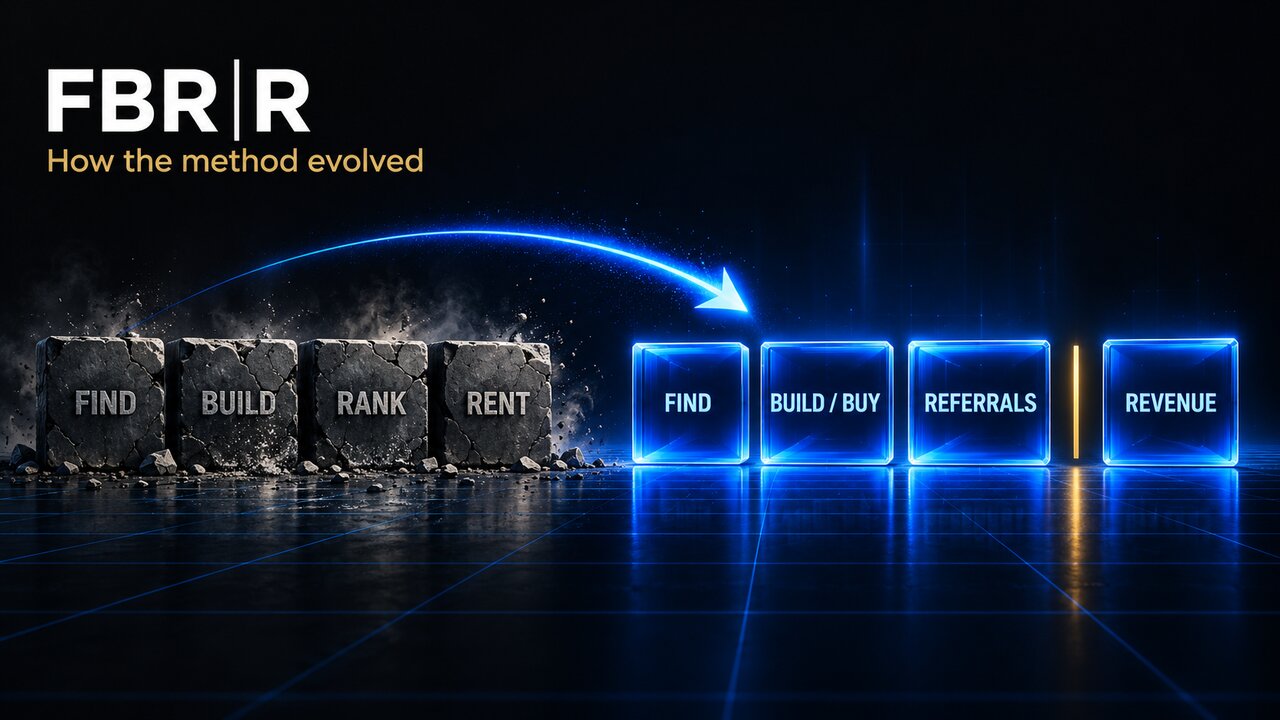
For years I taught rank and rent as four steps: Find, Build, Rank, Rent. Find a keyword, build a website, rank it, rent it. It worked, and the order mattered, so I kept it simple.
On October 1, 2026, I changed it. The letters are almost the same, but two of the words are different and one got bigger. It's now FBR|R: Find, Build/Buy, Referrals | Revenue. Here's why each change happened.
The old four steps
The original version described exactly how I worked. I'd find a keyword worth going after, build a site for it, rank that site in Google, and rent it to a local business for a monthly fee. Ranking created the traffic, the traffic created the leads, and the leads made the site worth renting.
That's still a good way to do it. The problem was that the steps described one path, and the business no longer has only one path.
Why Rank had to go
Rank was never the goal. It was the way I got to the goal. What a local business actually pays for is leads: the call, the form, the email from someone who needs the service now.
When Mike Veail joined us and I watched how he and Parrish work, it was obvious. Their sites earn because they generate leads, and ranking is only one way to get there. A site can produce leads from Google, from AI search, from paid ads, or because you bought it already producing.
So the third step became Referrals. A referral is any customer the site sends to a business. The step means: do whatever it takes to get the site generating them. Ranking is still how I teach it most, because it's the cheapest traffic there is, but it isn't the only way.
Why Rent became Revenue
The last step used to be Rent because renting was the only way I made money from a site. You found a business owner, made the deal, and they paid you every month.
Pay per lead changed that. Instead of renting the site to one business, you can send the calls to a pay per lead network that already has business owners buying calls in that niche and city. The network pays you for every call that qualifies. There's no renter to find and no sales call.
Rent described only one of those, so the step became Revenue, with two paths under it. Direct to Buyer is the classic rank and rent: one business, one monthly fee. Pay per Lead is the network model. The same site works either way, and a common move is to start a new site on pay per lead and move it to a direct renter once you find the right business owner.
Build became Build or Buy
The second step got wider. Building the site yourself is still the default, whether that's on an exact match domain, a partial match, or an expired domain that already carries trust. But you can also buy a lead site that's already built and producing.
Either way, you end up owning the asset. That's what the step is really about, so it became Build/Buy.
Why I kept the letters
I worked hard to keep the letters. People in the community already knew the method as FBRR, and the order still holds: you don't build before you've confirmed the opportunity, you don't chase leads before the site is built properly, and you don't try to get paid for a site that isn't producing.
The bar between Referrals and Revenue is new. The first three steps are the work that creates the asset. Revenue is what the asset earns. Keeping them visually separate makes that clear.
What it looks like now
You find the opportunity, build or buy the site, get it generating referrals, and then earn revenue from it, either by renting it to a business or by selling the leads. I call the result a Digital Lead Asset: a site you own that produces leads, earns monthly, and can be sold later.
The full breakdown of each step, with the tools I use for each one, is on the FBR|R method page.