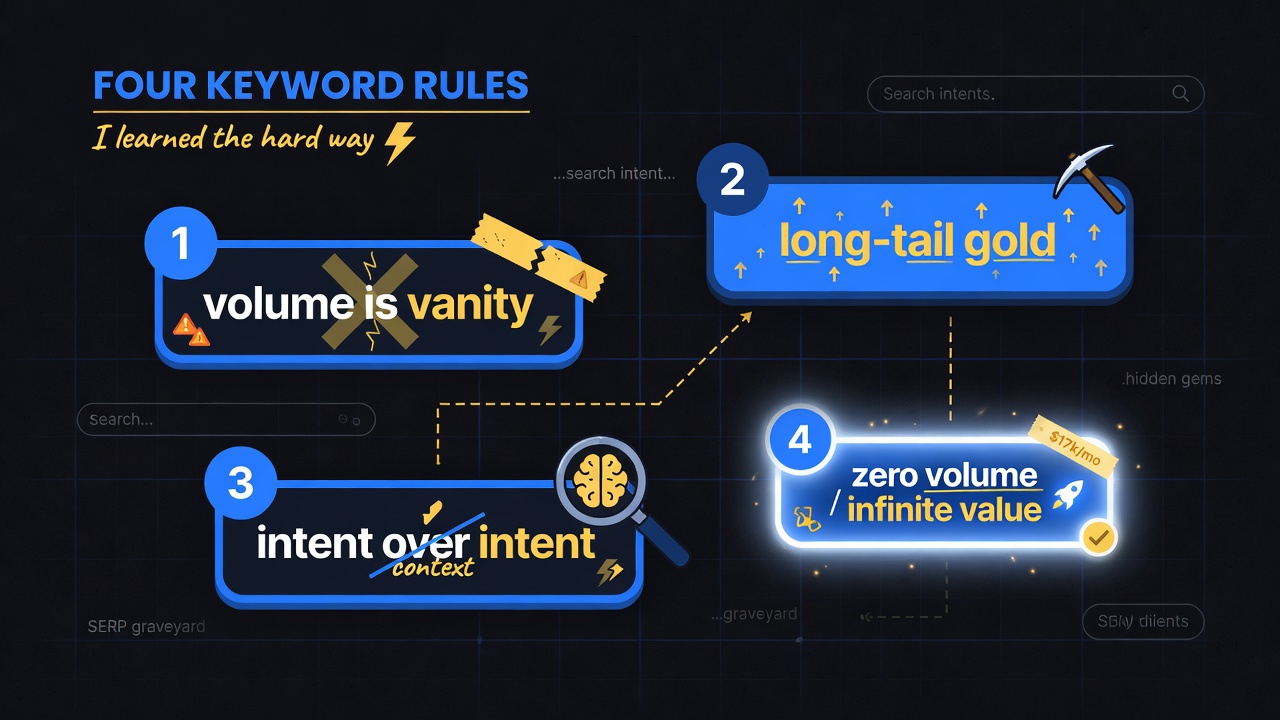
Keyword research is where most lead-gen sites are won or lost, and it's also where the standard advice is the least useful. The beginner guides teach you to chase volume, sprinkle in "near me," and brainstorm a list of cities and services. Every one of those moves has cost me money at some point, which is exactly how I learned they were wrong.
I already wrote a whole post on the biggest idea: your competitors already did your keyword research, so use their validated keywords instead of guessing. This post is the next layer down. Four judgment calls that sit underneath the research itself, the ones that took me years and a few dumb mistakes to get right.
1. Zero volume can still print money
The first time a keyword tool showed me a flat zero, I almost skipped the keyword. Then I remembered a client I've had for six or seven years: a printer repair company in Vancouver. Every single target I rank them for reads zero volume. Zero. And they've paid me every month for the better part of a decade because the leads never stop.
Here's what's actually happening when a tool shows zero. That number comes from advertiser data: how many people are bidding on the term and how much Google can infer from that auction. When nobody bids on a keyword, Google has no clean way to report its volume, so it shows zero. Google shows zero because nobody bids, not because nobody searches.
Plenty of real, high-intent searches live in that blind spot. Niche commercial services, obscure sub-trades, B2B repair work: the people typing those queries are ready to hire, but no advertiser is fighting over them, so the data goes dark. If you only build for keywords with visible volume, you walk right past some of the easiest, stickiest clients you'll ever land. When my own industry knowledge tells me a search exists, I trust that over a tool that's structurally blind to it.
The discipline: don't treat zero as "no demand." Treat it as "no advertisers," which is often a quieter way of spelling "no competition."
2. Never optimize for "near me"
"Near me" is one of the most searched phrases in local. So people reasonably assume they should stuff it into their titles. I did too, early on. It's wasted real estate, and here's why.
Google appends the proximity logic itself. When somebody searches "plumber near me," Google already knows where they are and serves local results automatically. It doesn't need you to put "near me" in your title tag to understand that you're a local business. Your map-pack and organic placement get sorted by proximity whether you mention it or not.
Your title tag is the most valuable few words on the page. Every word in it should be doing real work: the exact service, the location, the strongest commercial term you can fit. Spend two of those precious words on "near me" and you've handed away space that could have held a keyword Google actually ranks you on, to satisfy a phrase Google was going to handle for you anyway.
I always include the real location in my research and my titles, because the geo-modified search ("plumber Phoenix") is explicit demand I want to capture. But "near me" is demand Google routes for free. Optimize for what the engine won't do on its own, not for what it already does.
3. Find keywords, don't create them
This is the mistake I see kill more keyword plans than any other, and it's seductive because it feels like work. You have a national list of services, you put a city in front of each one, and you call it a keyword plan. "Excavation company" becomes "excavation company Ogden." Done, right?
You just guessed. That 8,100-a-month search volume on "excavation company" is national. How many of those searches happen in Ogden? Maybe a handful. Maybe zero. Sticking a city name on the front of a national keyword doesn't make it a real local search; it makes it a hypothesis you dressed up as data.
I learned this watching it happen live. A student had a Project Planner full of fat national numbers, building broad pages off them, and the local relevance just wasn't there. The fix was to stop inventing and start finding: re-run the research filtered to the actual city, and look at what real local searchers are actually typing. When the city came back nearly empty, that was the answer, not a problem to muscle through. You can't make traffic. You go find where it already is.
If your research starts by brainstorming a list and bolting a location onto it, it starts with a guess. Real keyword research is extraction, not invention. You pull what the market is already searching and already rewarding, and you build for that. The keywords exist or they don't, and your job is to discover which, not to will them into being.
4. Customer language beats industry language
I have a friend who sells commercial racking systems. He wanted to rank for the terms he uses inside his business: the precise engineering nomenclature, the spec-sheet language. Those terms had basically no search volume. Meanwhile the plain, almost crude phrases his customers actually type had real volume behind them, and he didn't want to target those because they felt beneath the product.
That instinct is backwards, and it's an expensive one. Your customer doesn't search the way you talk shop. They search in their own words: simpler, vaguer, sometimes technically wrong. The homeowner doesn't know the difference between an attorney and a lawyer, even though the search results for those two words differ enough that I treat them as separate pages. They just type whatever's in their head when they need help.
When you optimize for industry language, you're writing for your peers and your ego, not for the person holding the phone. When you optimize for customer language, you meet the actual buyer at the exact moment they're looking for you. Serve the customer first and Google comes around, because Google is trying to serve that same customer. The two of you are aimed at the same person; the only question is whether you're using their words or yours.
The thread that ties all four together
Read those four back and the same principle runs through every one. Zero volume, "near me," city-stuffing, industry jargon: each mistake comes from trusting your own assumptions over what's actually being searched. The tool's blind spot, the engine's built-in behavior, the difference between finding and inventing, the gap between how you talk and how your customer talks.
Keyword research isn't a brainstorm and it isn't a vocabulary test. It's the discipline of getting out of your own head and reading what the market already told you. The market ran the experiment. Your job is to stop guessing and read the results.