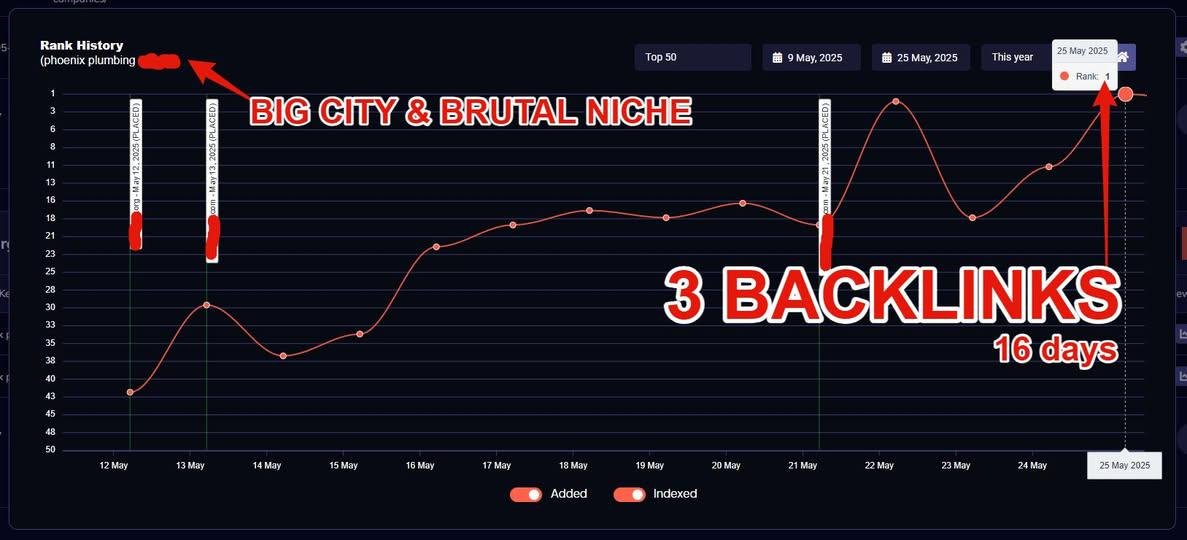
There’s a myth in SEO and lead gen that just won’t die.
That all the good keywords are gone.
That big cities are “too competitive.”
That niches like plumbing, roofing, HVAC are already locked up.
Those beliefs alone stop more people than Google ever will.
The truth is simpler and far more uncomfortable.
Opportunities are still everywhere.
Most people just don’t have a process that gives them a real chance of finding them.
This post is about that process.
Not SEO tactics.
Not link building.
Not content.
Just how to consistently uncover EMD opportunities that can actually rank and make money, even in markets people swear are impossible.
The core idea you need to understand first
Every big city and even the most brutal niches have what I call a chink in the armor, or sometimes many chinks in the armor.
The armor is page one of Google.
Not the niche.
Not the city.
Page one.
If page one is strong, you don’t touch it.
If page one has weak, replaceable results, you have chinks in the armor.
That’s it.
Everything that follows exists to help you:
- Surface the right keywords
- Quickly determine which results on page one (and how many) are replaceable
Here's the 3 phases of finding killer EMD's in Big Cities / Brutal Niches.
Phase 1: Get the list
(This is where most people already fail)
You are not brainstorming keywords.
You are collecting data.
There are two reliable ways to do this.
Method 1: Steal what’s already ranking
Take the top sites ranking for a service in a city and pull their ranking keywords.
Almost every SEO tool on the planet can do this cheaply.
This gives you:
- keywords Google already trusts
- real buyer intent phrases
- location relevance baked in
Method 2: Location-first keyword expansion
Use a keyword tool that can return keywords containing a specific word.
Examples:
- phoenix
- new york
- maui
- los angeles
This instantly forces location relevance into the list.
*You can even use a niche as your seed keyword here, and once you apply Step 2 filters, you’ll get a list of locations.
Either method works.
Both together are even better.
At this stage, your list will be messy. That’s expected. So let's clean it up even more.
Phase 2: Filter for money
This step alone removes 80 percent of bad ideas.
You are not filtering to find perfection.
You are filtering to give yourself the best odds.
Volume filter
For local service keywords, I like:
- 200–500 searches per month for smaller population
- 500-800 for decent sized cities
- 800-1200 for state capitals
Why?
“Plumber” might have 40,000 searches.
“Plumber New York” might have 800.
Lower volume does not mean weaker intent.
It usually means more specific intent.
Specific searches convert better and are easier to rank.
CPC filter
CPC is one of the most underused signals in SEO, because most SEO’s never think to correlate ad budget to niche profitability.
Businesses compete hardest for keywords that bring leads.
Rough correlations:
- $10 CPC often reveal tree services or lower-ticket maintenance style services
- $30+ CPC are often found in roofing, plumbing & contractor type services.
- $50+ CPC often brings high priced professional services like lawyers, plastic surgeons & insurance or mortgage related services.
A CPC filter doesn’t guarantee profitability, but it strongly implies it.
A tree service company cannot afford $50 clicks.
A lawyer cannot even find $10 clicks.
CPC tells you what type of business is fighting for that keyword.
Advertiser Competition filter
This is not ranking difficulty as many think.
This tells you how many businesses are actively competing against each other to spend money to show up and buy clicks.
If advertiser competition is near zero, that’s a red flag.
If businesses aren’t bidding, there’s usually a reason.
When you combine:
- relevant volume
- solid CPC
- real advertiser competition
You are left with mostly real service keywords that make money.
At this point, your list is no longer random.
It’s distilled.
Phase 3: Identify replaceable results
(This is the most important step)
Take each remaining keyword and look at page one.
You are not evaluating content quality.
You are not judging design.
You are not scoring word counts.
You are asking one question:
Is page one wearing armor… or does it have a chink?
If most of page one is strong, you move on.
If even a few results are weak, you’ve found your opening.
There are two main patterns you are looking for.
Pattern 1: Authority directories pretending to be competition
These are sites like:
- Angi
- BBB
- Yelp
- YellowPages
They mainly rank because of domain authority, not because the page itself is strong.
Good signs:
- Your EMD keyword not specifically in their meta titles
- A low number of page-level links (often 0–5)
These are placeholders, not competition.
They are often the easiest results to replace with a properly targeted EMD.
Pattern 2: Local business sites ranking by accident
These are real businesses, but with:
- Your EMD keyword not specifically in their meta titles
- Poor/weak link profiles
I often see these sites with DA or PA in the 20–40 range with hundreds of backlinks and still outrank them with an EMD and just a few links because intent and optimization are laser focused.
If you see:
- DA in the teens
- Non exact titles
- minimal links
You are going to rank fast.
This is how I ranked these big cities brutal niches:
- Phoenix Plumbing
- SEO Maui
- Pool Resurfacing Phoenix
- so many others
And each of those sites ranked with:
- Less than 5 backlinks total.
- ZERO citations
- ZERO social profiles
- ZERO tiered linking structures
Not because the niches were weak.
Because page one was for that one specific keyword that I registered as an EMD (Exact Match Domain).
Understand why this entire process works!
At this point, it’s important to understand why this process works.
An EMD already does part of the job for you.
It aligns:
- domain
- intent
- service
- location
When page one is weak, clarity beats authority.
That’s why I’ve ranked EMDs in:
- big cities
- brutal niches
- with very few links
The EMD isn’t magic.
It just amplifies the opportunity when the opportunity exists.
And that’s where most people actually fail.
Not because opportunities are gone.
Not because niches are saturated.
But because:
- they don’t believe openings still exist
- and they don’t have a process that gives them a real chance of finding them
This framework doesn’t guarantee wins.
It stacks probabilities in your favor.
The more keywords you run through this lens, the more chinks in the armor you find.
How To Automate The Entire Process
After doing this manually for years, I hit a wall.
The thinking was solid.
The results were real.
The process was just slow.
So I built a tool that runs this entire workflow from A to Z.
It:
- finds relevant keywords
- applies volume, CPC, and advertiser filters
- analyzes page one
- identifies replaceable results
- scores each opportunity with what I call a KILL SCORE (0–100)
The Kill Score reflects how strong the opportunity actually is.
I still do this manually when I need to sanity-check a revealed opportunity, but the platform removes 90% of the work. I find Killer EMD’s in seconds, not hours.
I built a software that helps find killer EMD opportunities in seconds instead of hours.
First published in my Rank & Rent SEO For the AI Era Facebook group.